
The Hours Ranking Freezes Adequacy as One Scoreboard
One weekly-hours axis freezes floor, relative line, and phase-out as a ranking of adequacy.
A circulated OECD ranking measures the weekly hours a single adult must work at the statutory minimum wage, while still claiming guaranteed benefits, to reach a relative poverty line set at 50 percent of national median disposable income. In the version most often shared, Japan requires 14 hours, most European countries fall between 20 and 45, and the United States stands at 80. That figure is exact under those instruments: a low federal floor, a high relative line, and means-tested withdrawal. The ranking becomes a puzzle only when that residue is frozen as inadequate benefits or an insufficient floor, then used to justify expanding the same class of transfer whose structure produces the hours.
The ranking compresses three instruments onto one hours axis
Self-distinguishing activity occurs — uncaused, unceasing. Call it the Mind: the observer already underway, every act of which is a distinction. Observation holds effect. A bar labeled 80, a bar labeled 14, a caption that says “escape poverty” — these register as effects. The instruments that produced them remain at least one step ahead of the look that freezes them as a ranking of national adequacy.
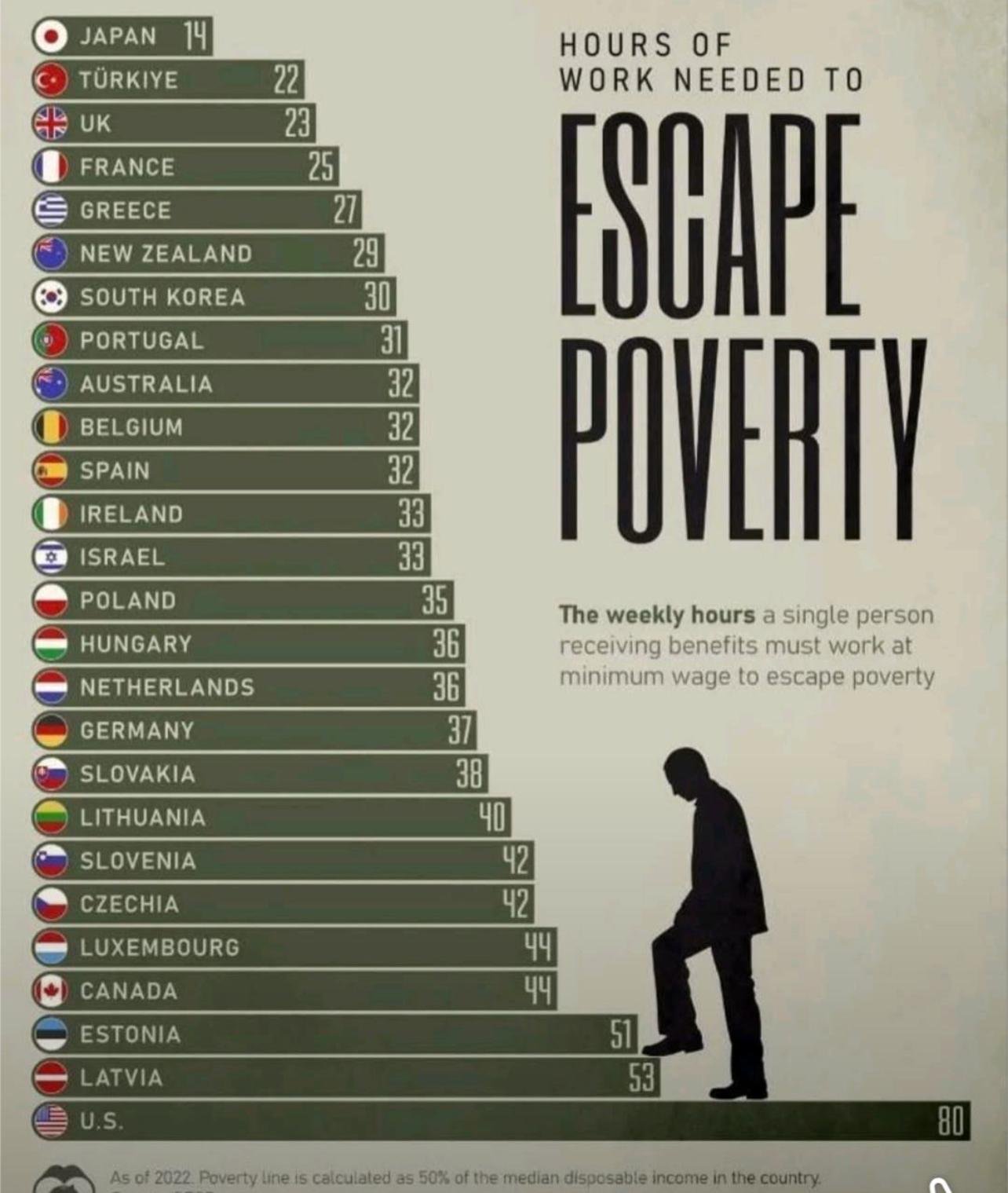
The chart ranks countries by a single weekly-hours figure. Three independent instruments enter that figure. The poverty line is relative: 50 percent of each country’s median disposable income, so a richer median raises the dollar threshold. The wage used is the statutory minimum, whose height relative to that median varies widely. Guaranteed benefits are already in the starting income, and their phase-out schedules determine how much of each additional hour remains as net. Compressing those three onto one hours axis forces independent distinctions onto a single scoreboard until “hours needed” reads as total character of the society rather than as the interaction of the instruments. Ownership cost freezes lagged averages as vehicle property is the same compression under premium costume: separate channels collapsed until one scoreboard authors the object. Here the object is the country.
Poverty, minimum wage, and benefits do not name the same thing across the ranking. Relative lines scale with each median. Statutory floors sit at different distances from that median. Benefit floors and withdrawal rates differ in design. The hours figure is already a freeze of those differences. A society with a higher median and a higher benefit standard relative to its statutory floor will print more hours without that print measuring a second, independent shortfall.
The United States outlier is exact under those instruments
The U.S. federal minimum wage has remained $7.25 an hour since 2009. American median disposable incomes are among the highest in the OECD, so the relative poverty threshold is correspondingly high in absolute dollars. Programs such as SNAP supply a modest income floor; the phase-out schedules of those and related means-tested benefits produce high effective marginal tax rates. Starting from that floor and then confronting withdrawal, the arithmetic demands many hours at the statutory rate before net income clears the relative line.
That is exact under the stated assumptions. It is the interaction of a low federal floor, a high relative threshold, and scheduled withdrawal. Many U.S. states already sit above the federal floor; the ranking uses the statutory federal figure. Freezing that one floor as “the United States” is the same compression one step later: a local instrument held as the country’s total wage character.
A realistic low-wage benchmark dissolves the outlier
A parallel OECD calculation replaces the statutory minimum with a more realistic low-wage benchmark — 67 percent of the national average wage. Under that metric the United States requires about 26 hours, near the OECD average of 21. Japan, on the same benchmark, sits near 16. The extreme outlier is therefore specific to the combination of a low federal floor, a high relative line, and benefit phase-outs. Change one instrument — the wage benchmark — and the ranking reorders.
The average is residue, not the engine is the adjacent freeze when an aggregate is held as author of the pattern. Here the hours ranking is that aggregate: composition of three instruments scored as if it were the engine of adequacy. The reordering under a different wage input is evidence that the first scoreboard never held what it claimed to rank.
Withdrawal rates disable net gain from additional hours
Once transfers are in place, their phase-out design leaves recipients with little net from additional hours. The transfer itself reallocates resources already produced. The rate at which it is withdrawn cancels most of the gain from work at the statutory floor. That is the mechanism named a poverty trap: continuation is drawn from managing the income register while the relative signal of additional hours is suppressed.
The trap is the structure of means-tested withdrawal under a low statutory floor and a high relative line. The misallocation of cause in wealth-transfer policies and price floors is the adjacent face: the measured wage or payment installed as the variable to set by decree, the relative signal that would have closed the gap suppressed. Here the measured hours are that installation under ranking costume. When the effect authors the frame is the same topology: the felt or projected register is granted causal priority, and available responses reorganize around managing it. The register here is the hours bar.
The scoreboard authors the next transfer
The chart’s circulation does not turn on restoring the three axes. It is invoked as evidence that benefits remain inadequate or that the wage floor must be raised further. In that framing the measured symptom — hours required — is treated as justification for expanding the same class of policies whose structure contributes to the measured gap. Readings that restore the instruments — smoother phase-outs, coordination of in-work supports, recognition that many state floors already sit above the federal number — circulate less, because they do not reinforce the preferred direction.
The preferred reference renews itself: more of the same transfer, a higher floor, held as ground. Consequences of that preservation re-enter as the hours figure, then arrive as alien — “what happened in the United States,” a puzzle awaiting a better answer. The look keeps searching for an answer that would reinforce the same class. Symptom and cause in the narratives of progress is delayed registration treated as engine: the loud residue is installed as lever while the generating sequence stays earlier. Here the loud residue is the 80-hour bar. Residual individualism is the restore under collective-focus costume: the ranking and the policies it is used to justify are residue of many discrete acts, not independent engines that can author the next hour of net income.
The figure registers the interaction
The hours figure is residue of a low statutory floor, a high relative line, and means-tested withdrawal. Softening into “the numbers are neutral; only their use is not” reinstalls two facts where only one sequence operated: instruments produced a residue, and that residue was frozen as a ranking of adequacy. The puzzle appears when the freeze is used to justify expanding the same transfer and floor that produce the hours. Restore the three axes and the figure is usable. It registers how the instruments interact. It does not measure how much more of the same class is required. The observational cut in AI debates is that freeze when two labor movements, or two price segments, are scored as one decisive number.